How to Pick a Monitor for Your PC: Complete 2026 Buying Guide
Choosing the right monitor for your PC can feel overwhelming with all the technical jargon—refresh rates, panel types, aspect ratios, and color gamuts. Whether you need a primary workstation display, a gaming screen, or an agile secondary portable monitor, understanding your core workflow requirements makes the decision easy.
In this 2026 buying guide, we break down screen size, resolution, connectivity, and panel technology so you can invest in the perfect display for your setup.

Step 1: Identify Your Primary Use Case
- Office Productivity & Remote Work: Prioritize 1080P Full HD or 1200P (16:10) resolution, wide IPS viewing angles, low blue light eye-care modes, and simple USB-C connectivity.
- Content Creation & Design: Prioritize color accuracy (100% sRGB or DCI-P3 coverage), high contrast, and consistent backlight uniformity.
- Console & Casual Gaming: Prioritize fast response times (3ms–5ms), smooth 60Hz or 120Hz refresh rates, and low input latency.
Step 2: Choosing the Right Screen Resolution
Resolution determines pixel sharpness and available desktop real estate. Here is how common standards compare:

Step 3: Connectivity & Port Compatibility
Modern displays must interface seamlessly with your devices:
- Full-Featured USB-C (DP Alt Mode): Carries power, audio, and high-definition video over a single reversible cable. Perfect for modern laptops, MacBooks, and Android phones.
- Mini-HDMI / HDMI: The universal standard for desktop GPUs, gaming consoles (PS5, Nintendo Switch, Xbox), and video capture cards.
- 3.5mm Audio Jack: Allows direct connection of external headphones or desktop speakers.
Step 4: Form Factor: Desktop vs. Portable Monitor
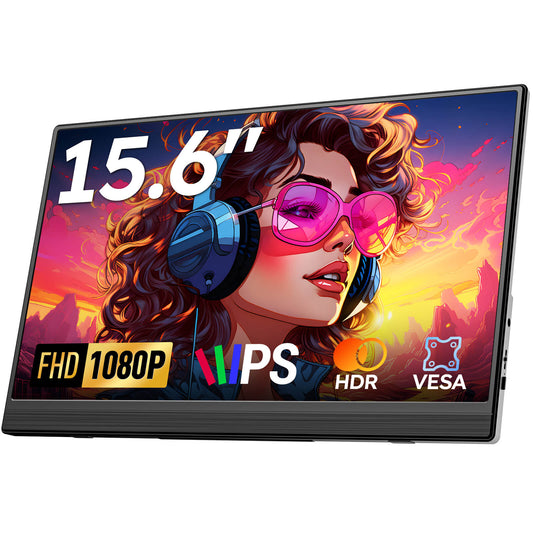
Traditional desktop monitors anchor you to one desk. In contrast, modern portable monitors like the Favpista 15.6" FHD Portable Monitor deliver equivalent Full HD IPS visual quality in an ultra-slim 1.5 lb aluminum chassis with a protective folding kickstand. You can use it as a desktop secondary screen by day and slip it into your laptop sleeve for cafe work or travel by night.
Recommended Favpista Displays
- Favpista 15.6" FHD 1080P Plug & Play Portable Monitor: The ultimate versatile PC companion with dual USB-C, Mini-HDMI, and smart stand cover.
- Favpista 10.5" IPS HDR Ultra-Compact Monitor: Compact 100% sRGB screen perfect for minimalist desks and console gaming.
- Favpista 14.1" 16:10 FHD 1200P Triple Screen Extender: Complete 3-screen laptop expansion for power multitaskers.
- Browse All Favpista Portable Displays: Explore our full collection of lightweight external monitors.
FAQ
Q:What is the ideal screen resolution for a PC monitor?
For portable monitors under 16 inches, 1080P Full HD (1920×1080) or 1200P (1920×1200) is ideal, delivering sharp 140+ PPI visuals without excessive battery drain or scaling issues.
Q:Why are IPS panels preferred over TN or VA panels?
IPS (In-Plane Switching) panels deliver superior 178-degree viewing angles and precise color accuracy, preventing image washout when viewed from off-center angles.
Q:Can I connect a portable monitor to a desktop PC graphics card?
Yes. Connect the monitor to your desktop GPU using the included Mini-HDMI to HDMI cable, and plug the USB cable into any USB port or wall charger for power.
Q:What is the benefit of a 16:10 aspect ratio over 16:9?
A 16:10 aspect ratio provides 11% more vertical viewing area, enabling you to view more lines of code, spreadsheets, and documents without scrolling.
Q:Do Favpista monitors include all necessary connection cables?
Yes. Each monitor includes a Full-Featured USB-C cable, Mini-HDMI to HDMI cable, USB power cable, and a protective folding smart stand cover in the box.