Portable Monitor with Built-In Battery vs. Non-Battery: Complete 2026 Guide
For frequent business travelers, remote workers, and outdoor professionals, a portable monitor is the ultimate accessory for productivity on the move. However, when selecting an external display, one critical hardware choice fundamentally determines your daily travel experience: Should you buy a portable monitor with an integrated internal battery, or a standard non-battery model powered directly by your laptop?
In this comprehensive 2026 comparison guide, we evaluate battery runtime, weight impact, airline travel regulations, and device charging capabilities to help you decide which display type fits your lifestyle.

What is a Battery-Powered Portable Monitor?
Unlike standard external monitors that rely entirely on the host laptop's battery or a wall outlet for power, a battery-powered display houses a rechargeable lithium-polymer battery pack (typically 5,000mAh to 10,800mAh). For example, the Favpista 14.1" Touchscreen Lapdock features an integrated 10,800mAh battery that powers the display, keyboard, and trackpad while reverse-charging your connected smartphone or handheld console.
Pros & Cons: Built-in Battery vs. Non-Battery
Portable Monitor with Built-In Battery
- Pros: Zero drain on your laptop or phone battery; completely independent operation on flights, trains, and coffee shop patios without power outlets; can act as an emergency power bank to reverse-charge your smartphone.
- Cons: Adds weight (typically 300g–500g heavier); slightly thicker chassis; battery cells degrade after 3–5 years of continuous cycling.
Non-Battery Portable Monitor (Bus-Powered)
- Pros: Ultra-lightweight (often under 1.5 lbs / 680g); ultra-slim profile (4mm–9mm); unlimited operational lifespan with no battery degradation over time; more affordable.
- Cons: Drains 30% to 40% of your laptop's battery runtime when connected via a single USB-C cable; may require a secondary USB wall charger or external power bank for extended sessions.
Direct Specification Comparison
Which One Should You Choose?
- Choose a Battery-Powered Model If: You frequently work in transit (airplanes, trains, outdoor job sites), use Samsung DeX or smartphone desktop modes on the go, or cannot risk draining your laptop's battery during client presentations.
- Choose a Non-Battery Model If: You prioritize minimum backpack weight, always work near wall outlets or carry a high-capacity laptop power bank, and want a display that lasts for years without battery capacity loss.
Recommended Favpista Portable Displays
- Favpista 14.1" Touchscreen Lapdock with 10800mAh Battery: Complete mobile workstation with internal battery, integrated keyboard, and multi-touch display.
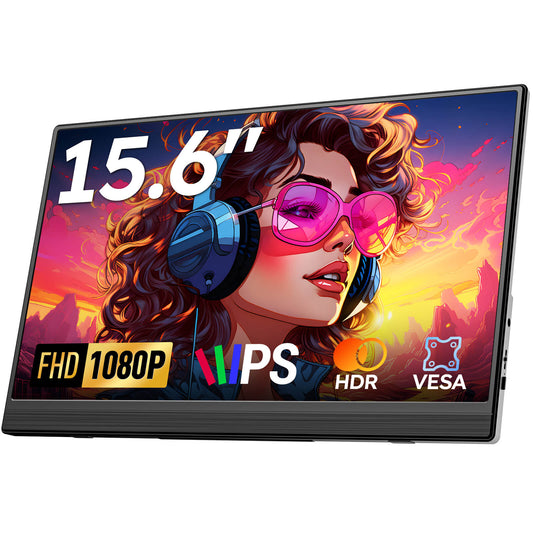
- Favpista 15.6" FHD 1080P Plug & Play Portable Monitor: The ultimate ultra-lightweight non-battery companion (under 1.7 lbs) with single-cable USB-C and Mini HDMI inputs.
- Favpista 14.1" 16:10 FHD 1200P Triple Screen Extender: Panoramic dual-screen wings for laptop multi-tasking.
- Browse All Favpista Portable Displays: Explore our full collection of lightweight, travel-friendly external monitors.
FAQ
Q:How long does a battery-powered portable monitor last?
Most battery-integrated portable monitors last between 4 and 6 hours on a single charge at 50% brightness. High-capacity 10,800mAh models can run for up to 7–8 hours under normal office workloads.
Q:Can you bring a battery-powered portable monitor on an airplane?
Yes. Standard portable monitor batteries (up to 10,800mAh / ~40Wh) are well below the FAA and TSA 100Wh limit for carry-on luggage. Note that lithium battery devices must be kept in carry-on bags, not checked luggage.
Q:Can a battery-powered monitor charge my phone?
Yes. Many advanced models, such as the Favpista 14.1" Lapdock, feature reverse charging capabilities that supply power to your connected phone while displaying Samsung DeX or screen mirroring.
Q:Can a non-battery portable monitor be powered by an external power bank?
Yes. Any standard power bank delivering 5V/2A or 15W+ Power Delivery can power a non-battery portable monitor through its secondary USB-C port, giving you the best of both worlds.
Q:Do battery portable monitors support passthrough charging?
Yes. When plugged into a wall outlet via USB-C PD, the monitor powers its display while simultaneously recharging its internal battery and passing power through to your connected laptop or phone.