720P vs. 1080P vs. 4K: Which Resolution is Best for Portable Monitors? (2026 Guide)
When selecting a new display or portable monitor, display resolution is typically the first specification advertised. Terms like 720P (HD), 1080P (Full HD), and 4K (Ultra HD) appear on spec sheets everywhere. But what do these numbers actually mean, and more importantly: which resolution is best for a 14-inch to 15.6-inch portable monitor?
In this 2026 display analysis, we compare pixel counts, pixel density (PPI), laptop battery consumption, and operating system UI scaling to help you choose the ideal resolution for work, travel, and mobile gaming.

Understanding Pixels, Resolution & PPI
Every digital display consists of a grid of microscopic sub-pixels (Red, Green, Blue) that illuminate to compose images. Resolution represents the physical pixel dimensions of that grid:
- 720P (Standard HD): 1280 × 720 pixels = 921,600 total pixels. Common on older tablets and entry-level streaming devices.
- 1080P (Full HD / FHD): 1920 × 1080 pixels = 2,073,600 total pixels (more than double 720P). The global industry standard for laptops, monitors, and gaming consoles.
- 1200P (FHD+ 16:10): 1920 × 1200 pixels = 2,304,000 total pixels. Provides 11% more vertical height for reading documents, coding, and spreadsheets.
- 4K (Ultra HD / UHD): 3840 × 2160 pixels = 8,294,400 total pixels (four times the pixels of 1080P). Delivers extreme pixel density for large desktop monitors.
Why 1080P is the Sweet Spot for Portable Monitors
While 4K sounds impressive on paper, on a 15.6-inch portable screen, 1080P Full HD remains the overwhelmingly preferred choice for real-world mobility:
- Retina-Level Sharpness: At 15.6 inches viewed from 18–24 inches away, 1080P achieves 141 PPI. The human eye cannot distinguish individual pixels at standard desk distance.
- Battery Longevity: 4K panels consume twice the wattage of 1080P screens. Running 4K over USB-C cuts laptop battery life down to 2 hours, whereas the Favpista 15.6" FHD Portable Monitor delivers all-day efficiency.
- Zero GPU Overhead: Gaming consoles like Nintendo Switch output native 1080P. Driving a 4K panel with non-native signals causes interpolation blur, whereas 1080P displays run natively with 0ms scaler latency.
Recommended Favpista Displays
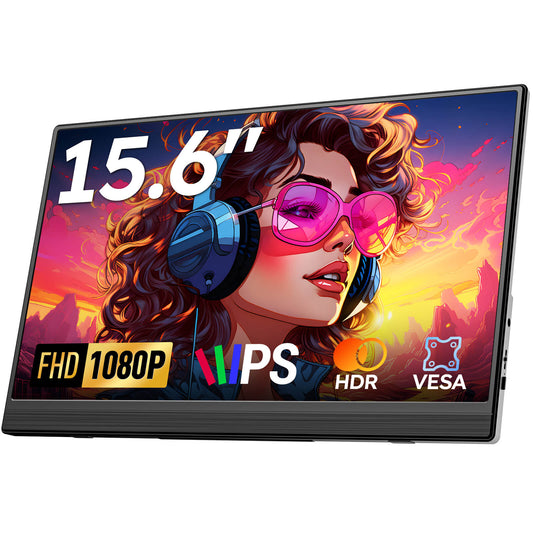
- Favpista 15.6" FHD 1080P Plug & Play Portable Monitor: The ultimate sweet spot for clarity, power efficiency, and universal device compatibility.
- Favpista 14.1" 16:10 FHD 1200P Triple Screen Extender: 1200P vertical expansion providing 11% more usable vertical space for multitasking.
- Favpista 14.1" Touchscreen Lapdock with 10800mAh Battery: Complete mobile setup with built-in battery, keyboard, and touchscreen.
- Browse All Favpista Portable Displays: Explore our full collection of lightweight, travel-friendly external monitors.
FAQ
Q:Is 1080P resolution sharp enough for a 15.6-inch portable monitor?
Yes. On a 15.6-inch screen, 1080P delivers 141 pixels per inch (PPI). Text is sharp and crisp without requiring heavy scaling, making it the ideal balance between clarity and performance.
Q:Why do 4K portable monitors drain laptop batteries so quickly?
4K displays require four times as many sub-pixels and a significantly brighter backlight to transmit light through denser pixel apertures, consuming 12W–16W compared to 6W for 1080P panels.
Q:What is the advantage of 1920×1200 (16:10) over 1920×1080 (16:9)?
16:10 provides 120 extra vertical pixel rows (11% more screen height). This reduces scrolling when reading documents, editing spreadsheets, and writing code.
Q:Can gaming consoles run at 4K on portable monitors?
The Nintendo Switch outputs a maximum of 1080P in docked mode. While PS5 supports 4K, 1080P displays like the Favpista 15.6" provide native 1:1 pixel rendering with maximum frame rates.
Q:Why do icons look tiny on high-resolution screens?
As pixel density increases, interface elements shrink unless display scaling is adjusted. Windows and macOS automatically scale 1080P screens comfortably at 100% to 125%.